Introduction
When building a new business website, one of the biggest decisions is whether to use WordPress or invest in a completely custom website.
Both options can create professional, high-performing websites, but they differ significantly in cost, flexibility, development time, maintenance, and scalability.
For small businesses, choosing the right option can help control costs while providing the features needed for future growth.
So, custom website vs WordPress: which is better?
The answer depends on your business goals, budget, technical requirements, and how much customization you need.
What Is a Custom Website?
A custom website is designed and developed specifically for a business rather than being built primarily around an existing CMS theme or template.
Developers can create custom:
- Designs
- Features
- Databases
- User experiences
- Integrations
- Business processes
- Admin systems
Custom websites are often used when a business has requirements that standard platforms cannot easily handle.
What Is WordPress?
WordPress is a content management system (CMS) that allows businesses to create and manage websites without building the entire system from scratch.
WordPress can be extended using:
- Themes
- Plugins
- Page builders
- Custom development
- Ecommerce solutions such as WooCommerce
This makes it suitable for everything from simple business websites to large content-driven websites and online stores.
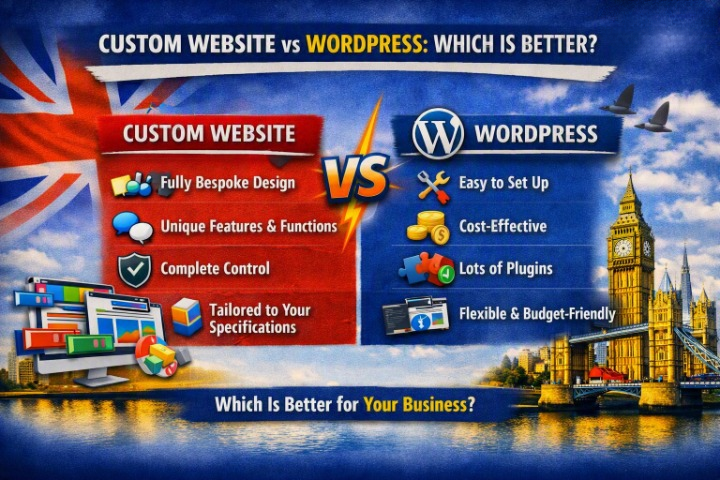
Custom Website vs WordPress: Quick Comparison
| Feature | Custom Website | WordPress |
|---|---|---|
| Initial Cost | Higher | Usually lower |
| Development Time | Longer | Faster |
| Customization | Excellent | Excellent |
| Ease of Management | Depends on development | Generally easy |
| SEO | Depends on development | Strong flexibility |
| Maintenance | Developer-dependent | Regular updates required |
| Scalability | Excellent | Excellent |
| Content Management | Custom-built | Built-in CMS |
| Plugins | Usually custom integrations | Thousands available |
| Best For | Complex requirements | Most businesses |
1. Cost
Cost is one of the biggest differences.
WordPress
WordPress can be relatively affordable because you can use existing themes, plugins, and hosting solutions.
Your costs may include:
- Domain
- Hosting
- Premium theme
- Plugins
- Development
- Maintenance
A basic small-business WordPress website can often be built for significantly less than a fully custom platform.
Custom Website
A custom website generally requires more development work.
Developers may need to build functionality from the ground up, increasing development hours and costs.
Winner: WordPress for most small businesses
2. Development Time
WordPress can usually be launched faster because many essential features already exist.
Developers can use:
- Pre-built themes
- Page builders
- Plugins
- Existing ecommerce functionality
- CMS features
A custom website may take considerably longer because the design and functionality need to be developed specifically for the business.
Winner: WordPress
3. Customization
Custom websites have an obvious advantage when highly specialized functionality is required.
Developers have greater freedom to create unique systems and workflows.
However, WordPress is also highly customizable.
A WordPress website can use custom themes, plugins, CSS, JavaScript, PHP, and APIs to create highly tailored experiences.
Winner: Custom website for highly specialized requirements
4. Ease of Content Management
WordPress was designed to make content management relatively straightforward.
Business owners can typically update:
- Pages
- Blog posts
- Images
- Services
- Products
- Menus
without changing the underlying website code.
A custom website can also have a user-friendly CMS, but this needs to be designed and developed as part of the project.
Winner: WordPress
5. SEO
Both options can be SEO-friendly.
With WordPress, businesses have access to tools for managing:
- Page titles
- Meta descriptions
- URLs
- Headings
- Internal links
- XML sitemaps
- Structured data
- SEO content
A custom website can also be technically excellent for SEO, but the quality depends heavily on the developers and implementation.
Winner: WordPress for convenience and flexibility
6. Website Speed
A custom website can be extremely fast because developers can control the code and only build the functionality required.
However, WordPress can also be very fast when properly optimized.
Performance problems usually come from factors such as:
- Poor hosting
- Unoptimized images
- Too many scripts
- Poorly coded plugins
- Excessive third-party tools
- Poor configuration
A well-built WordPress website can therefore provide excellent performance.
Winner: Depends on implementation
7. Security
Security depends on how the website is developed and maintained.
WordPress websites require regular updates for:
- WordPress core
- Plugins
- Themes
Poorly maintained websites can become vulnerable.
A custom website may have fewer third-party components, but custom code can also contain security vulnerabilities if it isn’t developed and maintained properly.
Winner: Depends on development and maintenance
8. Scalability
Both WordPress and custom websites can scale.
WordPress can support growing businesses through:
- Better hosting
- Caching
- Content delivery networks
- Database optimization
- Custom development
A custom website can be designed specifically around the expected scale of a business.
For highly complex systems with millions of users or unique workflows, custom development may eventually make more sense.
Winner: Tie
9. Plugins and Integrations
One of WordPress’s biggest advantages is its huge ecosystem of plugins.
You can add functionality for:
- Contact forms
- SEO
- Ecommerce
- Bookings
- Memberships
- Analytics
- Security
- Email marketing
With a custom website, similar functionality may need to be developed or integrated manually.
Winner: WordPress
10. Maintenance
WordPress websites need ongoing maintenance.
This may include:
- Updates
- Backups
- Security monitoring
- Plugin management
- Performance optimization
Custom websites also require maintenance, but the exact requirements depend on how the website was built.
If the original developer is unavailable, maintaining a custom system can sometimes be more difficult.
Winner: WordPress for most standard business websites
When Should You Choose WordPress?
WordPress is usually a strong choice if you:
- Run a small or medium-sized business
- Need a company website
- Want to publish blog content
- Need strong SEO flexibility
- Want to control website content yourself
- Have a limited or moderate budget
- Need common integrations
- Want to launch quickly
For many businesses, WordPress provides the right balance between cost, flexibility, and functionality.
When Should You Choose a Custom Website?
A custom website may be better if you need:
- Complex business logic
- Unique workflows
- Custom databases
- Advanced user portals
- Complex API integrations
- Specialized ecommerce functionality
- Highly customized dashboards
- Large-scale applications
If your website is essentially a web application rather than a traditional business website, custom development may be more appropriate.
Custom Website vs WordPress: Which Is Better for Small Businesses?
For most small businesses, WordPress is the better starting point.
A local service business, consultant, agency, restaurant, tradesperson, or professional company usually doesn’t need a completely custom platform.
WordPress can provide:
- Professional design
- SEO capabilities
- Easy content management
- Ecommerce options
- Flexible functionality
- Lower development costs
A custom website becomes more attractive when the business has requirements that WordPress cannot efficiently handle.
Can WordPress Be Customized?
Yes.
One common misconception is that WordPress websites must use standard templates.
In reality, developers can create:
- Custom WordPress themes
- Custom plugins
- Custom page templates
- Custom post types
- API integrations
- Bespoke functionality
This means you can have a highly customized website while still benefiting from WordPress as the CMS.
Custom WordPress vs Fully Custom Website
There’s also a middle ground.
Instead of choosing between a basic WordPress template and a completely custom platform, businesses can build a custom WordPress website.
This approach can provide:
- Custom branding
- Unique layouts
- Custom functionality
- WordPress content management
- SEO flexibility
- Lower costs than some fully bespoke platforms
For many growing businesses, this can be an excellent compromise.
Cost Comparison
The exact price depends on the project, but the general pattern is:
WordPress Website
Lower to moderate initial investment
Suitable for most small business websites.
Custom WordPress Website
Moderate investment
Suitable for businesses requiring a unique design or functionality.
Fully Custom Website
Higher investment
Best suited to businesses with complex technical requirements.
The cheapest option isn’t always the best. The goal should be to choose the technology that provides the functionality your business actually needs.
Final Verdict
So, custom website vs WordPress: which is better?
For most small businesses, WordPress is the better choice because it offers an excellent combination of affordability, flexibility, SEO capabilities, content management, and scalability.
A custom website becomes the better option when your business requires highly specialized functionality that standard CMS platforms cannot efficiently provide.
If you’re unsure, consider starting with WordPress and investing in custom development only where your business genuinely needs it.
The best website platform isn’t the one with the most advanced technology. It’s the one that helps your business achieve its goals without unnecessary cost and complexity.
Frequently Asked Questions
Is a custom website better than WordPress?
Not necessarily. A custom website provides greater control over specialized functionality, while WordPress is usually more practical and affordable for standard business websites.
Is WordPress good for small businesses?
Yes. WordPress is suitable for many small businesses because it offers flexible design, content management, SEO tools, ecommerce capabilities, and thousands of extensions.
Is a custom website more expensive?
Usually, yes. Custom websites generally require more development time, which can significantly increase the initial cost.
Can WordPress websites look completely custom?
Yes. A developer can create a custom WordPress theme and custom functionality, allowing the website to have a unique design and user experience.
Which is better for SEO: WordPress or custom development?
Both can perform well in search engines. WordPress provides many SEO tools and makes content management easier, while a custom website gives developers complete control over the technical implementation.
Should a startup choose WordPress or a custom website?
For most startups, WordPress is a practical starting point. A custom website may make more sense once the business has specialized requirements, complex workflows, or a need for a custom web application.