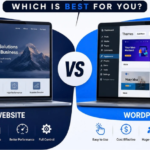
Choosing the right platform for your business website is an important decision. Two common options are WordPress and a custom website. Both can create professional websites, but they are suited to different needs, budgets, and technical requirements.
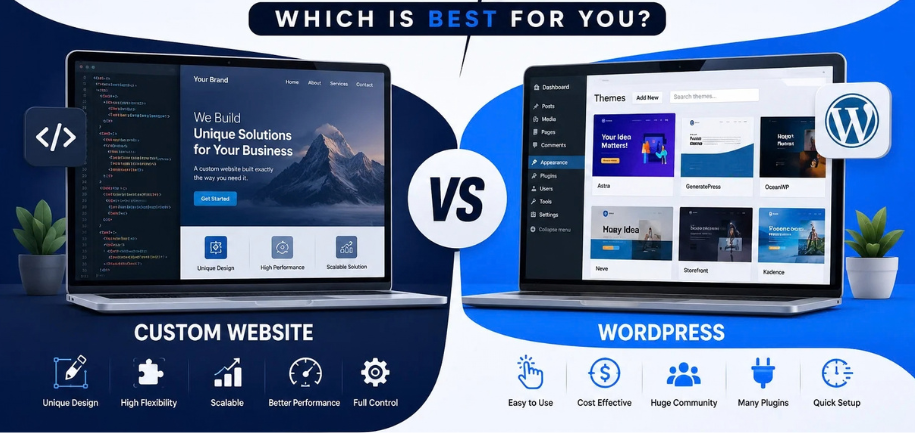
WordPress is a popular content management system that allows businesses to build and manage websites using themes, plugins, and custom development. A custom website is built specifically for a business, usually from the ground up, to meet its particular design and functionality requirements.
So, how do you choose between WordPress and a custom website?
The right choice depends on your budget, website goals, required features, level of customisation, maintenance needs, and plans for future growth.
What Is a WordPress Website?
WordPress is a content management system that allows users to create and manage websites without developing every feature from scratch.
A WordPress website can use:
- Pre-designed themes
- Plugins
- Page builders
- Custom themes
- Custom plugins
- Third-party integrations
- Custom code
This flexibility makes WordPress suitable for many types of websites, including business websites, blogs, portfolios, membership websites, and online stores.
What Is a Custom Website?
A custom website is developed specifically for a particular business or organisation.
Instead of starting with a standard theme and adding existing plugins, developers can create the website’s design and functionality according to the project’s requirements.
A custom website may include:
- Unique layouts
- Custom user interfaces
- Special functionality
- Custom databases
- Business system integrations
- Bespoke dashboards
- Advanced automation
- Custom applications
Custom development can provide greater control, but it normally requires more planning, development time, and investment.
WordPress vs Custom Website: Key Differences
The main differences can be seen in areas such as cost, development time, flexibility, maintenance, and scalability.
| Factor | WordPress | Custom Website |
|---|---|---|
| Initial cost | Usually lower | Usually higher |
| Development time | Often faster | Usually longer |
| Customisation | High | Very high |
| Themes and plugins | Available | Usually developed specifically |
| Maintenance | Regular updates required | Depends on the technology |
| Technical knowledge | Low to moderate | Usually higher |
| Scalability | Suitable for many businesses | Can be built around specific requirements |
| Content management | Easy | Depends on the system |
| Best for | Most standard business needs | Complex or highly specific requirements |
Consider Your Website Budget
Budget is one of the first things you should consider.
WordPress can be more affordable because you can use existing themes and plugins rather than developing every component from scratch.
A custom website usually requires more development work. Designers and developers may need to create the user interface, functionality, database structure, and content management system specifically for the project.
If your business has a limited budget, WordPress may provide a practical starting point.
If you have a larger budget and need specialised functionality, custom development may be worth considering.
Think About Your Website Requirements
Before choosing a platform, make a list of everything your website needs to do.
For example, a standard business website may require:
- Home page
- About page
- Services
- Contact form
- Blog
- Testimonials
- Gallery
- Team page
These requirements can usually be handled effectively with WordPress.
A business with more specialised requirements might need:
- Customer portals
- Custom booking systems
- Complex calculators
- Advanced dashboards
- Internal business tools
- Custom databases
- Complex third-party integrations
In these situations, a custom website may provide more flexibility.
Consider How Quickly You Need the Website
Development time can also influence your decision.
WordPress websites can often be launched relatively quickly because many components are already available.
A custom website generally requires more stages, including:
- Planning
- Research
- Wireframing
- UI design
- Development
- Testing
- Content integration
- Launch
If you need a website quickly, WordPress may be a suitable option.
If you have time for a longer development process, a custom website may allow more detailed planning and development.
How Much Customisation Do You Need?
Consider how unique your website needs to be.
WordPress provides a large amount of flexibility through themes, plugins, and custom development. However, some businesses may have requirements that do not fit easily into existing solutions.
A custom website can be designed around those specific requirements.
For example, if you operate a standard service business, WordPress may provide everything you need.
If you operate a business with a unique online system or complex customer workflow, custom development may be more appropriate.
Consider Website Maintenance
Maintenance is another important factor.
WordPress websites normally require regular updates for:
- WordPress core
- Themes
- Plugins
- Security
- Backups
- Compatibility
These updates help keep the website secure and functional.
Custom websites also require maintenance, but the type of maintenance depends on the technologies used to build the website.
If your custom website uses a specialised system, you may need a developer to handle future changes and technical issues.
Think About Content Management
If you plan to regularly publish content, consider how easily you need to manage the website.
WordPress provides a user-friendly content management system that allows businesses to update pages, publish blog posts, add images, and manage other content.
A custom website can also include a content management system, but the experience depends on how it was developed.
If your team needs to update content frequently without relying on a developer, make sure the chosen solution provides an easy editing experience.
Consider SEO Requirements
Both WordPress and custom websites can be optimised for search engines.
SEO depends on factors such as:
- Website structure
- Page speed
- Mobile usability
- Content quality
- Internal linking
- Metadata
- Technical SEO
- Website performance
WordPress provides many tools and plugins that can help with SEO tasks.
A custom website gives developers more control over the underlying code and structure, but good SEO still depends on how the website is designed and developed.
The platform alone does not guarantee search engine visibility.
WordPress Is Often Suitable for Small Businesses
WordPress can be a practical choice for many small and medium-sized businesses.
It may be suitable for:
- Local businesses
- Service companies
- Consultants
- Restaurants
- Professional firms
- Bloggers
- Agencies
- Portfolios
- Small ecommerce businesses
If your website mainly needs to present information and generate enquiries, WordPress can provide the required functionality without the cost of building everything from scratch.
A Custom Website May Suit Complex Businesses
A custom website may be more appropriate when your business requires functionality that is difficult to achieve with standard WordPress solutions.
Examples include:
- Complex customer platforms
- Large-scale web applications
- Custom marketplaces
- Advanced booking systems
- Business management systems
- Specialised calculators
- Custom reporting dashboards
- Complex integrations
In these situations, building the system around the business requirements can provide greater control.
Can WordPress Be Customised?
Yes. One important point to understand is that WordPress does not have to mean using a basic template.
Developers can create:
- Custom WordPress themes
- Custom plugins
- Custom post types
- Custom fields
- Custom integrations
- Custom functionality
This means a WordPress website can be highly customised while still benefiting from WordPress’s content management system.
For many businesses, this can provide a balance between flexibility and development cost.
Which Option Is Easier to Scale?
Both options can be scalable, but scalability depends on how the website is built.
A well-developed WordPress website can support a growing business when it is properly maintained and optimised.
A custom website can also be designed around expected future requirements from the beginning.
However, custom development may provide more control when a business has highly specific technical requirements.
The important thing is to choose technology that matches your expected growth rather than paying for complexity you do not currently need.
WordPress vs Custom Website Cost
The cost of a website can vary significantly depending on its requirements.
WordPress can reduce development costs because themes, plugins, and existing tools are available.
A custom website normally costs more because more components need to be designed and developed specifically for the business.
However, the cheapest option is not always the most suitable. A website that does not meet your business requirements may require expensive redevelopment later.
Questions to Ask Before Choosing
Before making your decision, ask yourself:
What is my budget?
Determine how much you can realistically spend on development and ongoing maintenance.
What features do I need?
Write down your essential features before choosing a platform.
Who will manage the website?
Consider whether you or your team will update the website or whether you will use a developer.
How quickly do I need it?
If you need a website quickly, a WordPress solution may be easier to launch.
Will my requirements change?
Think about what your business may need in the next few years.
Do I need unique functionality?
If your website requires highly specialised features, custom development may be worth considering.
When Should You Choose WordPress?
WordPress may be a good option if:
- You have a limited or moderate budget.
- You need a business website quickly.
- You want to manage your own content.
- You need a blog.
- Your website has standard business functionality.
- You want access to a large selection of plugins.
- You may need custom development later.
For many businesses, WordPress can provide enough flexibility without the cost of building an entire system from scratch.
When Should You Choose a Custom Website?
A custom website may be appropriate if:
- You need highly specialised functionality.
- Your business has complex technical requirements.
- You need a unique user experience.
- You require custom business systems.
- You need complex integrations.
- Standard plugins cannot meet your requirements.
- You have the budget for ongoing development.
Custom development is particularly useful when the website itself is an important part of how the business operates.
Final Thoughts
Choosing between WordPress and a custom website depends on what your business actually needs.
WordPress can be a practical choice for businesses that want a flexible, manageable, and cost-effective website with standard functionality. It can also be customised extensively when necessary.
A custom website may be more suitable for businesses with specialised requirements, complex systems, or functionality that cannot easily be achieved with standard solutions.
Before making a decision, consider your budget, required features, development timeline, maintenance needs, SEO requirements, and future plans.
The best approach is to choose the simplest solution that can reliably meet your current business requirements while leaving enough room for future growth.