A website should do more than simply exist online—it should help your business attract visitors, build trust, and generate leads. If your website receives traffic but isn’t converting visitors into enquiries or customers, there are likely underlying issues that need attention.
The good news is that most lead-generation problems can be identified and fixed. In this guide, we’ll explore the most common reasons why your website isn’t generating leads and what you can do to improve its performance.
1. Your Website Doesn’t Have Enough Traffic
Before expecting leads, people need to find your website.
If your website has very few visitors, your lead generation will naturally be limited.
Ways to increase traffic include:
- Improve your SEO
- Publish helpful blog content
- Use Google Business Profile
- Share content on social media
- Invest in Google Ads or social media advertising
- Build high-quality backlinks
More targeted traffic usually leads to more opportunities for conversions.
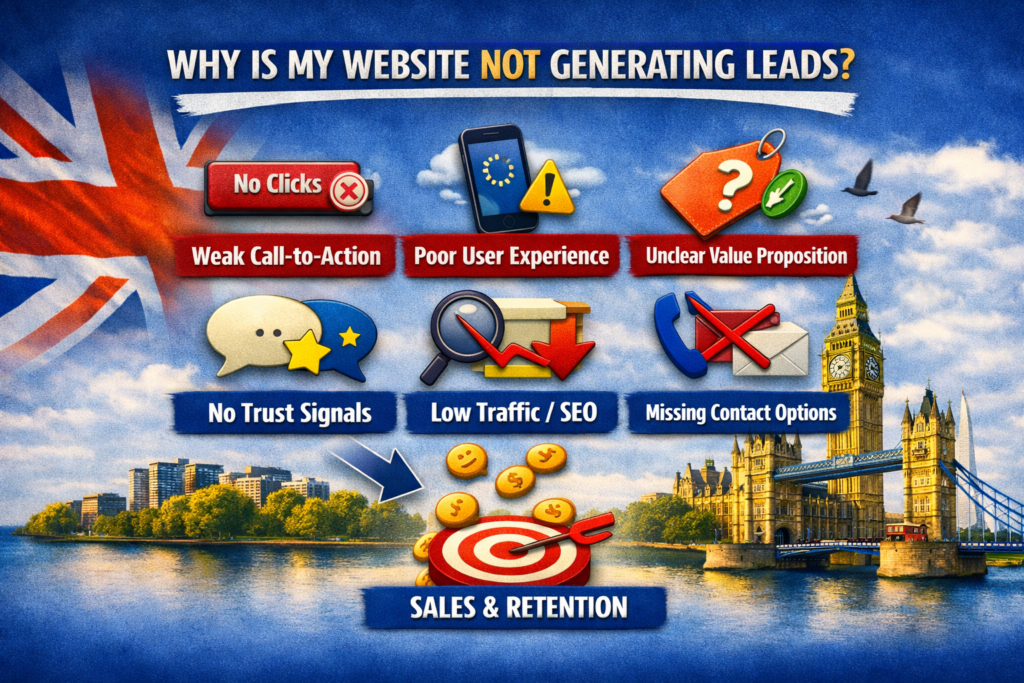
2. Your Website Isn’t Clear About What You Offer
Visitors should understand your business within a few seconds of landing on your homepage.
Ask yourself:
- Is your headline clear?
- Do visitors immediately know what you do?
- Are your services easy to understand?
Avoid confusing jargon and explain your value in simple language.
3. Weak or Missing Calls-to-Action (CTAs)
If visitors don’t know what to do next, they may leave without taking action.
Every important page should include a clear CTA, such as:
- Request a Quote
- Contact Us
- Book a Free Consultation
- Get Started Today
- Call Now
Make your CTA visible and easy to find.
4. Slow Website Speed
People expect websites to load quickly.
A slow website can increase bounce rates and reduce conversions.
Improve performance by:
- Compressing images
- Using fast hosting
- Enabling caching
- Minimising unnecessary plugins
- Optimising code and scripts
A faster website creates a better user experience and encourages visitors to stay longer.
5. Poor Mobile Experience
More than half of website traffic comes from mobile devices.
If your website isn’t mobile-friendly, visitors may struggle to navigate, complete forms, or read your content.
Ensure your website:
- Adapts to different screen sizes
- Has readable text
- Uses easy-to-click buttons
- Loads quickly on mobile
A responsive design is essential for modern websites.
6. Your Contact Form Is Too Complicated
Long forms can discourage potential customers.
Only ask for information you genuinely need, such as:
- Name
- Phone number (optional if appropriate)
- Message
The easier it is to contact you, the more enquiries you’re likely to receive.
7. Lack of Trust Signals
Visitors are unlikely to contact a business they don’t trust.
Build credibility by including:
- Customer testimonials
- Reviews
- Case studies
- Certifications
- Awards
- Security badges
- Client logos
Trust signals reassure visitors that your business is reliable and professional.
8. Your Website Isn’t Optimised for SEO
If your website doesn’t rank well in search engines, potential customers may never discover it.
Focus on:
- Keyword research
- Optimised page titles
- Meta descriptions
- Internal linking
- High-quality content
- Fast loading speeds
SEO is a long-term strategy that can generate consistent, organic leads.
9. Poor User Experience (UX)
Visitors should be able to find information quickly and easily.
Signs of poor UX include:
- Confusing navigation
- Cluttered layouts
- Broken links
- Hard-to-read text
- Too many pop-ups
A clean, user-friendly design helps guide visitors toward taking action.
10. Your Content Doesn’t Answer Customer Questions
People visit your website looking for solutions.
If your content is too brief or overly promotional, visitors may leave without engaging.
Create content that answers common questions, explains your services, and demonstrates your expertise.
Useful content builds trust and encourages enquiries.
11. No Lead Magnets or Incentives
Sometimes visitors need an extra reason to get in touch.
Consider offering:
- Free consultations
- Downloadable guides
- Checklists
- Free website audits
- Discount codes
- Product demonstrations
These incentives can increase conversion rates.
12. You’re Not Measuring Performance
Without data, it’s difficult to know what’s working.
Track important metrics such as:
- Website traffic
- Bounce rate
- Conversion rate
- Form submissions
- Page performance
- User behaviour
Tools like analytics and heatmaps can reveal where visitors drop off and what improvements are needed.
How to Improve Website Lead Generation
If your website isn’t producing enough enquiries, focus on these proven improvements:
- Improve page speed
- Strengthen your SEO
- Add clear calls-to-action
- Simplify contact forms
- Publish helpful blog content
- Display testimonials and reviews
- Optimise for mobile devices
- Improve navigation
- Add trust-building elements
- Regularly test and update your website
Small improvements can have a significant impact on conversions over time.
Signs Your Website Is Performing Well
A high-performing business website typically:
- Attracts consistent organic traffic
- Ranks for relevant keywords
- Generates regular enquiries
- Loads quickly
- Provides a great mobile experience
- Has low bounce rates
- Encourages visitors to contact your business
If your website isn’t meeting these goals, it’s worth reviewing both its design and marketing strategy.
Conclusion
If your website isn’t generating leads, the problem usually isn’t just one issue—it’s often a combination of traffic, user experience, SEO, design, and trust. By identifying weak areas and making targeted improvements, you can turn your website into a valuable tool for attracting new customers and growing your business.
Remember, an effective website isn’t just visually appealing. It should clearly communicate your services, answer visitors’ questions, build trust, and make it easy for potential customers to take the next step.
Frequently Asked Questions (FAQs)
Why is my website getting visitors but no enquiries?
Common reasons include weak calls-to-action, poor user experience, lack of trust signals, unclear messaging, or contact forms that are difficult to complete.
How can I increase leads from my website?
Improve your SEO, optimise your landing pages, simplify contact forms, add customer testimonials, strengthen your calls-to-action, and ensure your website loads quickly on all devices.
How long does SEO take to generate leads?
SEO is a long-term strategy. Most businesses begin seeing noticeable improvements within 3 to 6 months, although results depend on competition and the quality of optimisation.
Can website design affect lead generation?
Yes. A modern, professional, and easy-to-navigate website builds trust and encourages visitors to take action, leading to higher conversion rates.
Should I redesign my website if it’s not generating leads?
If your website is outdated, slow, difficult to use, or no longer aligns with your business goals, a redesign can significantly improve lead generation and overall performance.