
Introduction
Your business website is one of your most important marketing tools. It represents your brand, attracts potential customers, provides information, and can generate leads or sales.
But websites don’t stay effective forever. Technology changes, design trends evolve, search engine requirements develop, and customer expectations continue to increase.
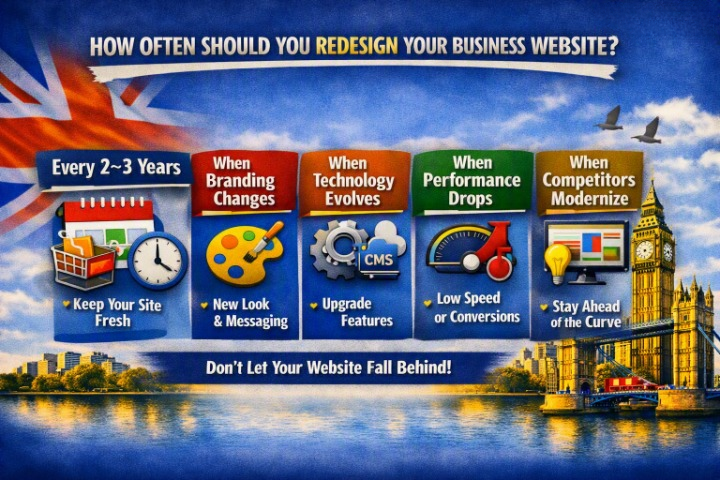
So, how often should you redesign your business website?
As a general rule, many businesses should consider a major website redesign approximately every 3 to 5 years. However, there is no universal deadline. A website may need a redesign sooner if it becomes outdated, slow, difficult to use, insecure, or ineffective at generating results.
This guide explains when you should redesign your website and the signs that indicate it may be time for an update.
How Often Should a Business Website Be Redesigned?
For most small and medium-sized businesses, a website redesign every 3–5 years is a reasonable guideline.
However, the actual timeframe depends on:
- Your industry
- Website technology
- Business growth
- Customer expectations
- Website performance
- SEO requirements
- Branding changes
- Mobile usability
A website that was redesigned two years ago may still perform perfectly, while an older website may already require a complete overhaul.
The important thing is to evaluate your website based on performance and business goals rather than age alone.
1. Your Website Looks Outdated
One of the most obvious signs is an outdated design.
Potential customers may lose trust if your website has:
- Old-fashioned layouts
- Low-quality images
- Difficult-to-read fonts
- Cluttered pages
- Outdated graphics
- Inconsistent branding
Your website doesn’t necessarily need to follow every design trend, but it should look professional and appropriate for your industry.
2. Your Website Isn’t Mobile-Friendly
A modern business website needs to work well across smartphones, tablets, laptops, and desktop computers.
Signs of poor mobile design include:
- Text that is too small
- Buttons that are difficult to tap
- Images overflowing the screen
- Horizontal scrolling
- Broken menus
- Slow mobile performance
If your website isn’t responsive, redesigning it should be a priority rather than waiting for a scheduled redesign.
3. Your Website Is Too Slow
Slow websites can frustrate visitors and negatively affect the overall user experience.
Common causes include:
- Large images
- Too many plugins
- Poor hosting
- Outdated code
- Unnecessary scripts
- Lack of caching
- Poor website optimization
If performance problems can’t be solved through optimization, a redesign may be the right solution.
4. Your Website Isn’t Generating Enough Leads
Your website should contribute to your business goals.
If you’re receiving traffic but very few:
- Contact form submissions
- Phone calls
- Quote requests
- Bookings
- Sales
your website may have conversion problems.
A redesign can improve:
- Calls to action
- Landing pages
- Navigation
- Forms
- Content structure
- Trust signals
The goal should be to make it easier for visitors to become customers.
5. Your Business Has Changed
Your website should accurately represent your current business.
You may need a redesign if you’ve:
- Changed your branding
- Added new services
- Entered new markets
- Changed your target audience
- Expanded your team
- Changed your business model
A website that doesn’t reflect your current business can confuse potential customers.
6. Your Website Is Difficult to Update
If adding a new service or changing a simple piece of text requires a developer every time, your website’s content management system may be outdated or poorly configured.
A modern website should make routine content updates relatively easy.
Consider a redesign if you’re spending too much time and money maintaining basic content.
7. Your Website Has Technical Problems
Technical issues can be another reason to redesign.
Watch for:
- Broken links
- 404 errors
- Plugin conflicts
- Outdated software
- Broken forms
- Browser compatibility issues
- Security vulnerabilities
If your website requires constant repairs, rebuilding it on a modern foundation may be more cost-effective.
8. Your Competitors Have Significantly Better Websites
Your competitors’ websites can provide useful benchmarks.
Compare:
- Design
- Navigation
- Page speed
- Mobile experience
- Content
- Calls to action
- Online booking or purchasing processes
If competing businesses provide a significantly better online experience, your website may be putting you at a disadvantage.
Don’t redesign simply because a competitor changed their homepage, but use competitor research to identify genuine gaps.
9. Your SEO Performance Is Declining
A redesign may be necessary if your organic traffic or search visibility has declined because of technical or structural problems.
Potential issues include:
- Poor site architecture
- Slow performance
- Mobile usability problems
- Duplicate content
- Broken links
- Poor internal linking
- Outdated content
However, don’t assume every SEO decline requires a redesign. Sometimes updating content or fixing technical SEO issues is enough.
10. Your Website Doesn’t Match Your Brand
Brand consistency matters.
Your website should match your:
- Logo
- Colours
- Typography
- Photography
- Messaging
- Overall brand identity
If your company has recently rebranded, your website should be updated accordingly.
11. Your Website Isn’t Accessible
Accessibility should be considered when reviewing an older website.
Potential problems include:
- Poor colour contrast
- Missing image descriptions
- Unclear form labels
- Difficult keyboard navigation
- Poor heading structure
- Unreadable text
Improving accessibility can make your website easier to use for a wider audience.
Redesign vs Website Refresh
Not every website needs a complete rebuild.
Website Refresh
A refresh may be enough if your existing website has a solid technical foundation.
You might update:
- Colours
- Fonts
- Images
- Content
- Homepage sections
- Calls to action
Full Website Redesign
A complete redesign may be necessary when:
- The technology is outdated
- The site isn’t mobile-friendly
- The structure is confusing
- Performance is poor
- Security is a concern
- The CMS is difficult to manage
Before rebuilding everything, determine whether the existing foundation can be improved.
How Long Does a Website Redesign Take?
The timeline depends on the size and complexity of your website.
A small business website might take around 4–8 weeks, while larger websites with ecommerce, custom functionality, integrations, and extensive content can take several months.
The process commonly includes:
- Website audit
- Goal setting
- Sitemap planning
- UX and wireframes
- Visual design
- Development
- Content migration
- SEO implementation
- Testing
- Launch
Planning carefully helps reduce delays and unexpected problems.
How to Redesign a Website Without Losing SEO
A redesign can accidentally cause traffic and rankings to drop if SEO isn’t considered.
Before launching a redesigned website:
- Keep important URLs where possible
- Create redirects for changed URLs
- Preserve valuable content
- Update internal links
- Check metadata
- Test your sitemap
- Fix broken links
- Verify mobile usability
- Monitor search performance after launch
SEO should be part of the redesign process from the beginning, not something added after the website goes live.
Website Redesign Checklist
Use this checklist when evaluating your website:
- Review website design
- Test mobile responsiveness
- Check page speed
- Review conversion rates
- Test contact forms
- Check broken links
- Review SEO performance
- Compare competitor websites
- Check website security
- Review accessibility
- Update outdated content
- Confirm branding is consistent
- Review CMS and technology
- Plan SEO redirects before launch
Final Thoughts
So, how often should you redesign your business website?
For many businesses, every 3–5 years is a useful starting point, but the right time depends on your website’s performance, technology, design, SEO, and business goals.
Don’t wait for an exact date if your website is already slow, difficult to use, insecure, or failing to generate leads.
A successful redesign isn’t simply about making your website look newer. It should improve the user experience, support your SEO strategy, increase conversions, and provide a stronger foundation for future business growth.
Frequently Asked Questions
How often should a small business redesign its website?
A small business should generally consider a major redesign every 3–5 years, while reviewing performance and usability much more frequently.
Is five years too long for a website?
Not necessarily. If your website remains fast, secure, mobile-friendly, easy to manage, and effective at generating business, it may not need a complete redesign simply because it is five years old.
Can I redesign my website without changing the domain?
Yes. You can redesign your website while keeping the same domain name. Keeping the domain can also simplify SEO and branding continuity.
Does redesigning a website improve SEO?
It can, particularly if the redesign improves technical SEO, mobile usability, page speed, site structure, and content. However, a poorly planned redesign can also cause SEO problems.
Should I redesign or build a completely new website?
If the existing website has a solid technical foundation, a redesign or refresh may be sufficient. If the technology, structure, or CMS is outdated, building a new website may be more practical.
How much does a website redesign cost in the UK?
Costs vary depending on the website’s size and complexity. A simple small-business redesign may cost a few thousand pounds, while larger ecommerce or custom projects can cost significantly more.