Introduction
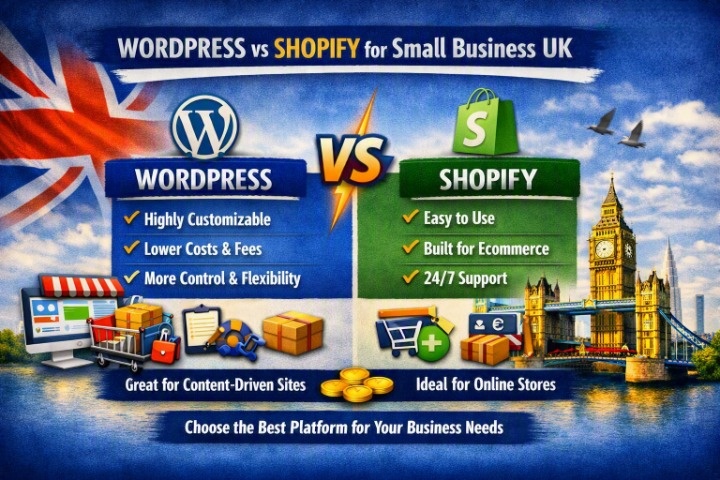
Choosing the right website platform is an important decision for any small business in the UK. Two of the most popular options are WordPress and Shopify, but they are designed with different priorities in mind.
WordPress offers extensive flexibility and customization, especially when combined with WooCommerce. Shopify, on the other hand, is a hosted ecommerce platform designed to make selling products online easier and faster.
So, which one is better for a small business in the UK?
The answer depends on whether your business needs a content-focused website, an online store, advanced customization, or a simple platform that requires minimal technical maintenance.
WordPress vs Shopify: Quick Comparison
| Feature | WordPress + WooCommerce | Shopify |
|---|---|---|
| Best for | Flexible business websites & ecommerce | Ecommerce businesses |
| Ease of use | Moderate | Easy |
| Customization | Excellent | Very good |
| SEO flexibility | Excellent | Very good |
| Ecommerce tools | Excellent with WooCommerce | Excellent |
| Hosting | Usually separate | Included |
| Security | Requires management | Mostly managed |
| Maintenance | More responsibility | Lower maintenance |
| Blogging & content | Excellent | Good |
| Scalability | Excellent | Excellent |
| Initial setup | More involved | Faster |
What Is WordPress?
WordPress is an open-source content management system that can be used to build almost any type of website.
For ecommerce, businesses commonly use WooCommerce, which adds online store functionality to WordPress.
With WordPress, you can customize virtually every part of your website, including:
- Design
- Navigation
- Product pages
- Checkout
- Blog
- SEO
- Forms
- Integrations
- Custom functionality
This flexibility makes WordPress particularly attractive to businesses that want complete control over their website.
What Is Shopify?
Shopify is an all-in-one ecommerce platform designed specifically for selling products online.
Unlike WordPress, Shopify includes hosting and many ecommerce features within the platform. This makes it possible to launch an online store without separately managing hosting, server configuration, and many technical tasks.
Shopify provides features for:
- Product management
- Shopping carts
- Checkout
- Payments
- Inventory
- Shipping
- Customer accounts
- Ecommerce analytics
- POS selling
1. Ease of Use
WordPress
WordPress offers a lot of flexibility, but that flexibility can make it more complicated.
You may need to manage:
- Hosting
- Themes
- Plugins
- Backups
- Security
- Updates
For businesses without technical knowledge, professional support can make WordPress much easier to manage.
Shopify
Shopify is generally easier for beginners because hosting, security, and many technical aspects are handled by the platform.
You can create products, customize your theme, manage orders, and configure your store without dealing with server administration.
Winner: Shopify
2. Website Customization
WordPress
WordPress is the stronger option when customization is a priority.
You can use themes, plugins, custom code, page builders, and WooCommerce extensions to create highly customized websites.
This makes WordPress suitable for businesses that want their website to do more than simply sell products.
Winner: WordPress
3. Ecommerce Features
Shopify has ecommerce functionality built into the platform, while WordPress requires WooCommerce or another ecommerce solution.
Shopify provides many ecommerce features out of the box, while WooCommerce allows businesses to build their store functionality through extensions and customization.
Winner: Shopify for simplicity
Winner: WordPress for customization
4. SEO
Both platforms can support strong SEO.
WordPress provides extensive control over:
- URLs
- Metadata
- Content
- Internal linking
- Structured data
- Blogging
- Technical SEO
Shopify also provides built-in SEO features, including options for metadata and search-friendly content.
For content-heavy businesses that rely heavily on blogging and organic traffic, WordPress often provides greater flexibility.
Winner: WordPress
5. Website Maintenance
This is one of the biggest differences between the two platforms.
With WordPress, you’ll generally need to manage or pay someone to manage:
- WordPress updates
- Plugin updates
- Theme updates
- Backups
- Security
- Hosting
- Performance
Shopify handles much of the underlying infrastructure and platform maintenance for you.
Winner: Shopify
6. Cost
The total cost of ownership can vary significantly depending on the website.
Shopify uses a subscription-based model, while WordPress itself is open source but requires expenses such as hosting, domain registration, themes, plugins, and potentially maintenance.
For example, UK pricing comparisons in 2026 show Shopify plans starting around £19 per month when billed annually, while WordPress costs depend heavily on the hosting and services selected.
Don’t compare only the monthly platform price. Consider:
- Website development
- Hosting
- Themes
- Plugins/apps
- Maintenance
- Payment fees
- Developer support
Winner: Depends on your requirements
7. Security
Shopify manages much of the platform-level security, hosting infrastructure, and maintenance.
With WordPress, website owners are responsible for keeping WordPress, themes, and plugins updated and properly secured.
A professionally maintained WordPress website can still be highly secure, but it requires more active management.
Winner: Shopify for simplicity
8. Blogging and Content Marketing
If content marketing is a major part of your strategy, WordPress is difficult to beat.
WordPress was originally developed as a publishing platform and provides extensive control over:
- Blog posts
- Categories
- Tags
- Content structure
- Internal links
- Landing pages
- SEO content
Shopify supports blogging, but WordPress generally provides more flexibility for content-heavy websites.
Winner: WordPress
9. Scalability
Both platforms can support growing businesses.
Shopify can scale effectively for ecommerce businesses that want a managed platform.
WordPress and WooCommerce can also scale significantly, particularly when properly hosted and optimized.
The better choice depends on how your business is expected to grow.
Winner: Tie
10. UK Ecommerce Considerations
UK businesses should consider local requirements and integrations when selecting a platform.
Depending on your business, you may need:
- UK payment gateways
- VAT handling
- Shipping integrations
- Royal Mail or courier integrations
- Cookie and privacy management
- GDPR-related processes
- Accounting integrations
Both WordPress/WooCommerce and Shopify have ecosystems that can support UK ecommerce requirements.
WordPress vs Shopify: Pros and Cons
WordPress + WooCommerce
Pros
- Highly customizable
- Excellent content management
- Strong SEO flexibility
- Large plugin ecosystem
- Full control over website
- Suitable for complex functionality
- Excellent for content-driven businesses
Cons
- Requires more maintenance
- Hosting is usually separate
- Plugin conflicts can occur
- Security requires attention
- More technical knowledge may be needed
Shopify
Pros
- Easy to use
- Fast to launch
- Hosting included
- Strong ecommerce features
- Lower technical maintenance
- Good security infrastructure
- Excellent for online stores
Cons
- Ongoing subscription costs
- App costs can add up
- Less control than WordPress
- Some advanced customizations require specialized development
- Greater platform dependency
Which Is Better for a Small Business?
The answer depends on your business model.
Choose WordPress if:
- You need a service-based business website.
- Blogging and SEO content are important.
- You want complete design control.
- You need custom functionality.
- You already use WordPress.
- You want maximum flexibility.
Choose Shopify if:
- Ecommerce is the main purpose of your website.
- You want to launch quickly.
- You don’t want to manage hosting.
- You prefer a simpler interface.
- You want less technical maintenance.
- Your store uses fairly standard ecommerce workflows.
Recent UK-focused comparisons similarly find Shopify particularly suitable for straightforward ecommerce, while WordPress is stronger for flexible, content-heavy, or highly customized websites.
WordPress vs Shopify: Which One Should You Choose?
For a small UK service business, such as a consultant, tradesperson, agency, restaurant, or local professional service, WordPress is often the better choice.
For a small UK business primarily selling physical products online, Shopify is often the easier choice, especially if you want to minimize technical maintenance.
If you need a combination of ecommerce, content marketing, custom functionality, and complete control, WordPress with WooCommerce can be the better long-term option.
Final Verdict
There is no universal winner in the WordPress vs Shopify debate.
Shopify wins for simplicity, ecommerce-focused businesses, and low-maintenance management.
WordPress wins for flexibility, content marketing, customization, and greater control.
Before choosing, consider your budget, technical skills, business model, SEO strategy, ecommerce requirements, and future growth plans.
For most small businesses, the best platform isn’t necessarily the one with the most features—it’s the one that makes it easiest to achieve your specific business goals.
Frequently Asked Questions
Is WordPress cheaper than Shopify?
It depends. WordPress software is open source, but you’ll need to account for hosting, themes, plugins, development, and maintenance. Shopify has predictable subscription costs, but apps and transaction-related costs can increase the overall expense.
Is Shopify better for ecommerce?
For businesses that want a straightforward online store with minimal technical maintenance, Shopify is often the easier option because ecommerce functionality and hosting are integrated into the platform.
Is WordPress better for SEO?
WordPress provides extensive control over content, URLs, metadata, site structure, and technical SEO, making it particularly powerful for businesses that rely heavily on content marketing.
Can WordPress compete with Shopify for ecommerce?
Yes. WooCommerce can turn WordPress into a powerful ecommerce platform and provides significant customization options.
Can I move from Shopify to WordPress later?
Yes, ecommerce stores can be migrated between platforms, but careful planning is required to preserve products, customer data, URLs, content, and SEO performance.
Which is easier for a beginner?
Shopify is generally easier for beginners because much of the technical infrastructure is managed for you. WordPress offers more flexibility but typically requires more hands-on management.