Introduction
If you’re planning to sell products online, one of the first questions you’ll probably ask is: How much does an ecommerce website cost in the UK?
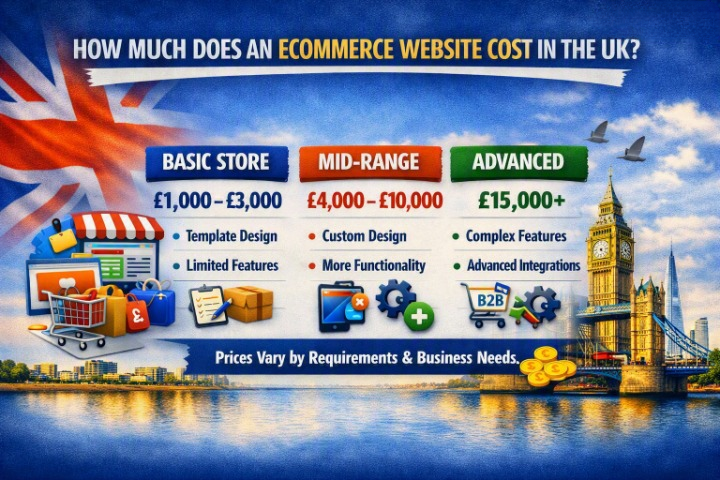
The answer depends on the platform, number of products, design requirements, payment methods, integrations, and level of customization. In 2026, UK ecommerce website projects commonly range from around £2,000 for a basic store to £25,000+ for a highly customized ecommerce platform. Some complex enterprise projects can cost significantly more.
Understanding these costs before starting your project can help you set a realistic budget and avoid unexpected expenses.
Average Ecommerce Website Cost in the UK
Here’s a general guide to ecommerce website costs in the UK:
| Type of Ecommerce Website | Typical Cost |
|---|---|
| DIY / Template-Based Store | £0–£1,500+ |
| Basic Professional Store | £2,000–£6,000 |
| Custom Shopify Store | £4,000–£15,000 |
| WooCommerce Store | £3,000–£15,000+ |
| Large Ecommerce Website | £10,000–£25,000+ |
| Bespoke Ecommerce Platform | £25,000–£100,000+ |
These are general 2026 market ranges rather than fixed prices. The final cost depends heavily on the project’s features and complexity.
What Affects Ecommerce Website Cost?
Several factors can significantly change the price of an ecommerce website.
1. Ecommerce Platform
The platform you choose is one of the first decisions you’ll need to make.
Popular options include:
- Shopify
- WooCommerce
- Wix
- BigCommerce
- Custom ecommerce platforms
Shopify generally offers a simpler managed solution, while WooCommerce provides greater control and flexibility but requires more technical management.
2. Website Design
A template-based website is usually cheaper than a completely custom design.
Template-Based Design
You start with an existing theme and customize:
- Colours
- Fonts
- Images
- Logo
- Product layouts
- Basic page sections
This is a good option for startups and small businesses.
Custom Design
A custom ecommerce website is designed specifically around your brand and customers.
It may include:
- Custom homepage
- Unique product pages
- Custom navigation
- Conversion-focused layouts
- Advanced animations
- Bespoke user experience
Custom design increases development costs but can create a stronger and more memorable brand experience.
3. Number of Products
The number of products can affect the cost of setting up an online store.
Adding 20 products is significantly different from importing 2,000 products with:
- Multiple variations
- Sizes
- Colours
- Categories
- Product filters
- Different prices
- Stock levels
Large product catalogues often require additional setup, data migration, and testing.
4. Ecommerce Features
Basic stores may only need product pages, a shopping cart, checkout, and payment processing.
More advanced stores may require:
- Customer accounts
- Product filtering
- Wishlists
- Subscriptions
- Discount systems
- Reviews
- Gift cards
- Wholesale pricing
- Booking functionality
- Product configurators
The more functionality you need, the higher your development cost is likely to be.
5. Payment Gateway Integration
Your website needs a reliable way to accept payments.
Depending on your target customers, you may need to support:
- Credit and debit cards
- PayPal
- Apple Pay
- Google Pay
- Bank payments
- Buy-now-pay-later services
Payment providers may also charge transaction or processing fees, so these should be considered separately from the website development cost.
6. Shipping and Delivery Integration
Shipping can become complicated when selling products across the UK or internationally.
Your ecommerce website may need:
- Delivery zones
- Shipping rates
- Free delivery rules
- Courier integration
- Tracking
- Click-and-collect
- International shipping
Simple shipping rules are relatively easy to implement, while advanced logistics integrations can increase project costs.
7. Third-Party Integrations
Growing ecommerce businesses often need their website to communicate with other systems.
Examples include:
- Accounting software
- CRM systems
- Email marketing platforms
- Inventory management
- Warehouse systems
- ERP software
- Courier services
- Customer support tools
Integrations can add significantly to the cost of an ecommerce project, particularly when custom API development is required.
Shopify Ecommerce Website Cost
Shopify is a popular choice for UK businesses because hosting, security, and much of the technical infrastructure are managed by the platform.
A professionally designed Shopify store can commonly cost around £2,000–£8,000, while custom Shopify projects can reach £10,000–£15,000 or more depending on the requirements.
You’ll also need to budget for:
- Shopify subscription
- Premium themes, if required
- Apps
- Payment processing
- Ongoing maintenance or development
Shopify can be a good choice if you want to launch quickly without managing your own hosting environment.
WooCommerce Ecommerce Website Cost
WooCommerce is an ecommerce solution for WordPress.
The WooCommerce software itself is free, but you’ll typically pay for:
- Hosting
- Premium plugins
- Theme or custom design
- Security
- Maintenance
- Development
A professional WooCommerce website can cost roughly £3,000–£15,000+, with more complex stores costing considerably more.
WooCommerce is particularly attractive for businesses that want greater control over their website and content.
Custom Ecommerce Website Cost
A completely custom ecommerce platform is the most expensive option.
A bespoke build may start around £15,000–£25,000 and can reach £50,000, £100,000 or more for highly complex requirements.
Custom development may be worthwhile if you require:
- Complex business logic
- Bespoke checkout
- Advanced product configuration
- ERP integration
- Custom customer portals
- Large-scale inventory systems
- Unique purchasing workflows
For most small businesses, however, a fully custom ecommerce platform is usually unnecessary.
Ongoing Ecommerce Website Costs
The initial development cost isn’t the only expense.
You should also budget for ongoing costs such as:
Hosting
WooCommerce websites require hosting, while Shopify includes hosting within its platform plans.
Domain Name
You’ll need to renew your domain name periodically.
Plugins and Apps
Premium ecommerce functionality may require monthly or annual subscriptions.
Maintenance
Regular updates, security monitoring, backups, and technical support may require an ongoing maintenance budget.
Payment Processing
Payment providers typically charge fees on transactions.
A realistic ongoing budget can range from tens to several hundred pounds per month, depending on the platform, apps, traffic, maintenance requirements, and business size.
How Much Should a Small Business Budget?
For a small UK business launching its first online store, a practical starting budget is around £2,500–£8,000 for a professionally built Shopify or WooCommerce website.
This could cover:
- Professional design
- Responsive development
- Product setup
- Payment integration
- Shipping configuration
- Basic SEO
- Contact pages
- Essential ecommerce functionality
- Testing and launch
If you need custom integrations or advanced functionality, a budget of £8,000–£15,000+ may be more realistic.
How to Reduce Ecommerce Website Costs
You don’t necessarily need to spend tens of thousands of pounds to launch a successful online store.
You can reduce costs by:
- Starting with a professional template
- Limiting custom functionality
- Launching with your most important products
- Using standard payment gateways
- Avoiding unnecessary apps
- Providing your own product descriptions
- Using optimized product images
- Adding advanced features later
Start with the features your customers actually need and expand as your business grows.
What Should Be Included in an Ecommerce Website Quote?
Before accepting a proposal, make sure the quote clearly explains what’s included.
Ask whether the price covers:
- Website design
- Development
- Responsive/mobile optimization
- Product setup
- Payment integration
- Shipping setup
- Basic SEO
- Content migration
- Testing
- Security
- Training
- Website launch
- Post-launch support
A cheap quote may not actually be cheaper if important services are excluded.
Ecommerce Website Cost Checklist
Before starting your project, consider these costs:
- Domain name
- Ecommerce platform
- Website design
- Development
- Hosting
- Premium theme
- Plugins or apps
- Product photography
- Product descriptions
- Payment processing
- Shipping integration
- SEO
- Security
- Maintenance
- Marketing and advertising
Planning these expenses in advance makes it easier to calculate your total ecommerce budget.
Final Thoughts
So, how much does an ecommerce website cost in the UK?
For 2026, a small professional ecommerce website will often fall somewhere around £2,000–£8,000, while more customized stores can cost £8,000–£25,000+. Bespoke ecommerce platforms can cost considerably more.
The cheapest option isn’t always the best option. Instead, focus on choosing a platform and development approach that matches your products, customers, budget, and long-term business goals.
For many small businesses, starting with Shopify or WooCommerce and adding advanced features as the business grows can provide a good balance between cost, flexibility, and scalability.
Frequently Asked Questions
How much does a basic ecommerce website cost in the UK?
A basic professional ecommerce website can cost around £2,000–£6,000, depending on the platform, design, products, and features required.
Is Shopify cheaper than WooCommerce?
Not necessarily. Shopify has predictable platform fees and managed hosting, while WooCommerce gives you more control but requires separate hosting, plugins, maintenance, and security management.
How much does a custom ecommerce website cost?
A custom ecommerce website can start around £15,000–£25,000 and increase significantly when advanced integrations and bespoke functionality are required.
How much does it cost to maintain an ecommerce website?
Ongoing costs vary considerably. Small stores may spend tens of pounds per month, while established stores with premium apps, maintenance, support, and other services can spend several hundred pounds per month.
Is an ecommerce website worth the investment?
For businesses that can generate consistent online sales, an ecommerce website can become a valuable long-term sales channel. The key is to invest in the features and functionality your customers actually need rather than overspending on unnecessary customization.